
Cherokee County Sex Offender Checks
The Texas Public Sex Offender Registry is the primary statewide source for Cherokee County registry checks. The Texas Department of Public Safety Crime Records Division maintains the computerized database under Code of Criminal Procedure Article 62.005. Ordinary public searches are free and do not require an account. Account access is used for public sex offender subscriptions and notification functions.
Use both person and geographic methods. A surname search can miss an alias or alternate spelling. A map or radius query depends on the address being geocoded and on the current address reported to the registry. Compare public descriptors before concluding that a same-name result is the intended person. Save the date of the search because location, custody, and verification information can change.
Cherokee County Registry Authorities
Texas law assigns local registration to the “local law enforcement authority.” For a person living within a municipality, that is ordinarily the police chief. For a person outside a municipality, it is ordinarily the sheriff, unless a centralized registration authority applies. Cherokee County residents should direct registration questions to the police department for the municipality or to the Cherokee County Sheriff's Office for an unincorporated address.
The Cherokee County Sheriff's Office is at 272 Underwood Street, Rusk, Texas 75785, with a main line of 903-683-2271. The county does not publish a specialized registry-unit name, counter schedule, or local public map, so those details should be confirmed by phone. Article 62.005(d) also permits a request for public registry information to local law enforcement, subject to a fee reasonably necessary to cover administrative costs. No local amount should be assumed.
Cherokee County Sheriff's Office
272 Underwood Street
Rusk, TX 75785
903-683-2271
Call to confirm the correct registry contact and current counter process.
Texas Public Sex Offender Registry Searches
The Texas registry supports person and geographic searches. Choose the method that fits the question, then run a second pass to reduce the chance of overlooking an alias or nearby address. Live labels and distance choices can change with a DPS release, so the current screen controls.
- Open the official Texas DPS registry and review its use terms and notices.
- For a known person, enter the last name and add first name, middle name, or date of birth when known. Try a spelling variant if needed.
- For a place check, select Cherokee County or use city, ZIP, or a sufficiently complete street address and the available radius control.
- Review map or list results, open a likely profile, and compare multiple public descriptors instead of relying on the name alone.
- Repeat the search through the national registry when the address or person may cross a county or state line, and call the registering authority about a material conflict.
| Search field or control | Type | Required | Use |
|---|---|---|---|
| Last Name | Text | Conditional | Starts a person search; test spelling variants where needed. |
| First or Middle Name | Text | Optional | Narrows similar surname results. |
| Date of Birth | Date or text | Optional | Use only when known and follow the live format. |
| Sex or Race | Dropdown | Optional | Live enumerated values can narrow person results. |
| County or City | Dropdown or text | Optional | Select Cherokee for a county-wide pass or narrow by city. |
| ZIP Code | Text | Optional | Runs a geographic search using a five-digit ZIP. |
| Address and Radius | Text and dropdown | Conditional | Requires enough address detail to geocode; confirm live radius options. |
Searches return registry entries. They do not predict future conduct and do not replace the filed court record for the underlying case.
Cherokee County Registry Radius Searches
An address-radius search should begin with a complete street address, city, and ZIP when possible. Check the map and list views, then broaden or narrow only with the distance choices on the live Texas DPS screen. A county boundary is not a safety boundary. An address near the edge of Cherokee County can make a neighboring-county or national layer useful.
A map pin depends on successful geocoding and currently reported data. It is not real-time surveillance, and it does not guarantee that a person is physically at a location at the moment of search. If a map and profile conflict, note the search date and contact the registering police department or sheriff rather than confronting anyone.
Note: A Cherokee County map result supports awareness, but it cannot guarantee current presence, compliance, identity, or future conduct.
Registry Profiles: What They Show
A public Texas registry profile combines identifying descriptors, reported location, registration status, and reportable case information. Article 62.005 also excludes several private fields. Read the whole profile before matching a person, especially when names are common. No private registrant's entry was used to create this inventory.
| Name and Aliases | The primary registered name plus aliases made public by the registry. |
|---|---|
| Photo and Description | An available photograph and public descriptors such as age, sex, race, height, weight, hair, eyes, scars, marks, or tattoos. |
| Reported Location | A residential address or a general-location description for a person without a fixed residence. |
| Offense and Court | Reportable offense description, penal citation, disposition date, jurisdiction, and registration basis where displayed. |
| Risk Level | A Texas numeric risk assessment for notification, not a federal duration tier. |
| Status and Verification | Registering authority, registration status, and available verification information. |
The public profile does not lawfully reveal a Social Security number, driver's-license number, telephone numbers, employer details, or identifying victim information. Certain juvenile registration information can also be ordered nonpublic under Article 62.352.
Cherokee County and National Registry Checks
The U.S. Department of Justice Dru Sjodin National Sex Offender Public Website, known as NSOPW, federates participating jurisdiction data. It is useful when a search crosses Texas lines or when prior locations may be in another state. The Texas DPS entry remains the controlling Texas source, and the local registering authority is the right office for a material Cherokee County discrepancy.
The official National Sex Offender Public Website supplies that cross-state search layer.
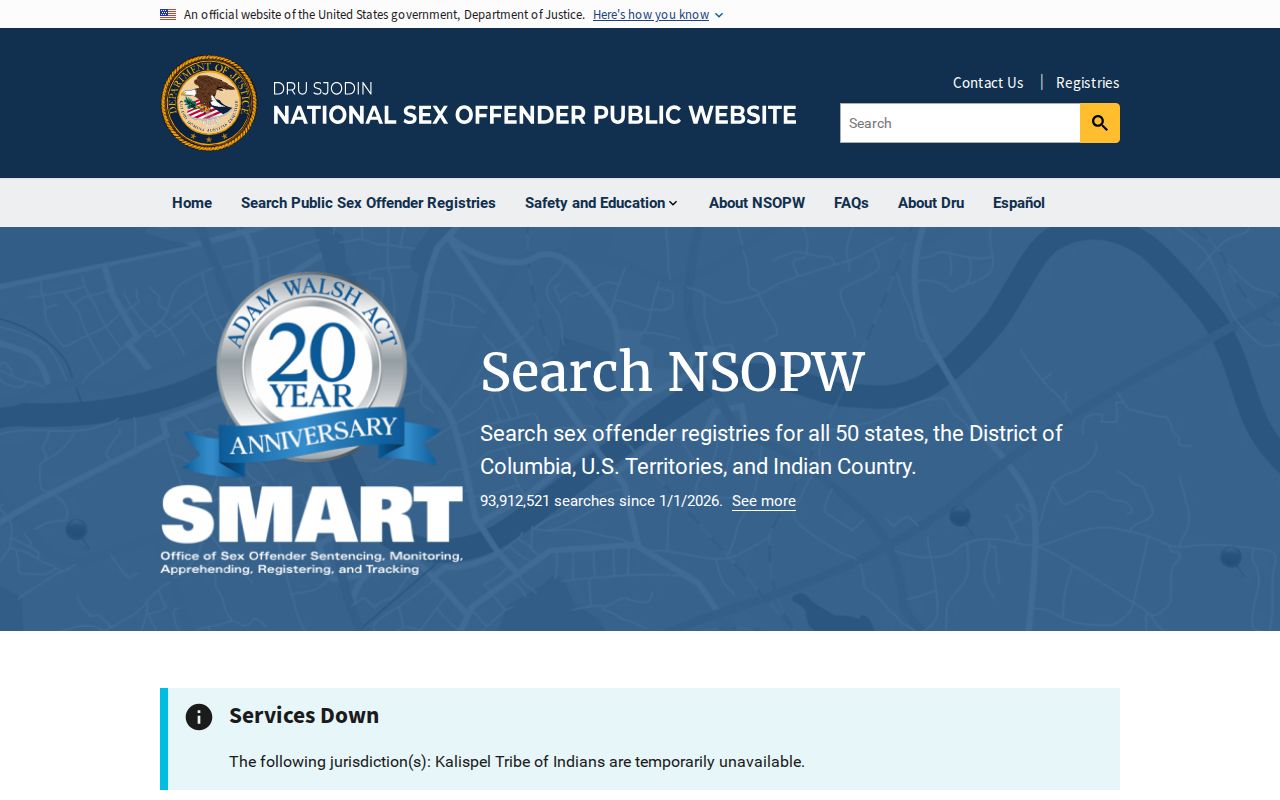
The national view broadens geography without turning a registry result into a full Cherokee County criminal case record.
Registration Levels and Duties in Texas
Texas numeric risk levels address danger assessment and notification. They do not set a simple 15-year, 25-year, or lifetime term. Duration is offense-based under Article 62.101, while verification frequency depends on statutory categories. These concepts must be read separately.
| Category | Texas rule | Duration or verification effect |
|---|---|---|
| Risk Level 1 | Low danger and not likely to engage in criminal sexual conduct | Does not itself set duration; no Level 3 neighborhood mailing rule. |
| Risk Level 2 | Moderate danger and may continue to engage in criminal sexual conduct | Does not itself set duration; supports ordinary statutory notification. |
| Risk Level 3 | Serious danger and will continue to engage in criminal sexual conduct | Does not itself set duration; triggers the statutory neighborhood notice rule. |
| Listed offense or repeat category | Article 62.101(a) | Generally lifetime, subject to specialized statutory relief. |
| Other adult reportable case | Article 62.101(b) | Generally ten years after the later statutory release, discharge, or disposition marker. |
| Verification | Article 62.058 | Generally annual, every 90 days for two or more reportable cases, and every 30 days for a civilly committed sexually violent predator. |
Juvenile cases use distinct rules and can involve court-ordered deferral, exemption, or nonpublic treatment. Early termination for certain federal minimum-registration cases requires the Subchapter I risk-assessment and court process. It is not automatic.
Cherokee County Registry Verification
Registrants must report required changes and verify at the frequency set by Texas law. Local authorities may schedule reasonable verification dates consistent with those rules. A delayed screen update alone does not prove noncompliance. Report a suspected discrepancy with the profile details and search date to the registering authority so it can verify the facts.
For a Level 3 registrant, Article 62.056 directs DPS to provide written neighborhood notice within the statutory area and deadline. The law generally uses a one-mile area in an unsubdivided location or three blocks in a subdivided location, with notice in English and Spanish. Local authorities may also use meetings, postings, or other authorized notice based only on public information.
Cherokee Registry Duration Questions
Do not estimate a Cherokee County registration end date from the numeric risk level. First read the profile's registration basis and offense. Then compare it with the current offense lists and timing rules in Article 62.101. Adult reportable cases outside the lifetime category generally use a ten-year period tied to the later statutory marker, while listed serious or repeat categories generally continue for life.
A reported address should not be labeled unlawful from the registry alone. Texas has no single statewide Chapter 62 school-or-park buffer applied to every registrant. Limits can arise from a person's parole or community-supervision conditions and from a valid local ordinance. Confirm the actual order and the municipality's current rule.
Using Registry Information Lawfully
Registry information supports personal, family, neighborhood, and community safety. It does not authorize threats, retaliation, public confrontation, or claims beyond the fields shown. When a suspected address or verification problem appears, record the relevant public details and contact the Cherokee County sheriff, the municipal police department, or DPS. Let law enforcement investigate compliance.
Texas Code of Criminal Procedure Article 62.063 makes it an offense to use registry information, with intent to injure, harass, or commit a crime, to identify a registrant. The offense is generally a Class B misdemeanor, or generally a Class A misdemeanor when the actor is a registrant. The statute also provides civil liability for damages, costs, and attorney's fees.
Misuse is a crime: Article 62.063 prohibits using Texas registry information with intent to injure, harass, or commit a crime. Do not confront a registrant.
Search results should be checked against the Texas profile, the national layer where appropriate, and the local registering authority when facts conflict. Community notification does not permit harassment.