
Jacksonville Criminal History Checks
A Jacksonville record check works best when the request follows the record's custodian. The Jacksonville Police Department holds its own incident and arrest reports. Jacksonville Municipal Court handles the city's fine-only cases, including Jacksonville police citations and charges filed by Jacksonville ISD for school-related violations. Cherokee County offices become relevant when an arrest leads to jail booking or a felony or Class A or B misdemeanor filing. The Texas Department of Public Safety adds a separate statewide layer for public conviction and deferred-adjudication information.
Use a precise sequence and keep any report number, citation number, full name, and event date at hand:
- Identify whether Jacksonville police, another agency, or the municipal court created the record.
- Request a Jacksonville police report through the police-specific open-records channel, with the event details and desired format.
- Contact Jacksonville Municipal Court for a city citation, plea, setting, payment status, or fine-only disposition.
- For custody or higher charges, check Cherokee County Jail and the correct county clerk after a case is filed.
- Use the Texas DPS conviction name search for its limited statewide public record, or fingerprints for an accurate review of your own record.
No-match Jacksonville results should be read with care. A Jacksonville police report can exist without a filed charge, and a city citation will not turn a county criminal-case search into a complete Jacksonville history.
Jacksonville Records by Custodian
Start with the badge or court name on the document. Jacksonville police keep reports created by their officers. The municipal court keeps its citation and fine-only case file. The Cherokee County Sheriff's Office keeps a county-jail booking record, while the District Clerk or County Clerk keeps a higher criminal case after prosecutors file it. These offices may hold records about the same event, but each record answers a different question.
| Record sought | Jacksonville starting point | What it establishes |
|---|---|---|
| Police incident or arrest report | Jacksonville Police Department | The officer's account and agency action |
| Fine-only citation | Jacksonville Municipal Court | City charge, plea, setting, and disposition |
| Custody intake | Cherokee County Jail | Booking and release or transfer data |
| Felony or Class A/B case | District Clerk or County Clerk | Filed charge and court outcome |
This split is the core of Jacksonville record access. Asking the jail for a Jacksonville police narrative or asking the city court for a Jacksonville felony judgment sends the request to the wrong custodian.
Records at Jacksonville Police Department
The Jacksonville Police Department lists 903-586-2546 as its main number and links both Crash Reports and Open Records Request resources. The department does not publish a searchable arrest blotter on the official site. A person seeking a Jacksonville report must therefore use the records request path and describe the existing record well enough for staff to locate it.
The city's police open-records page distinguishes police information from general city records. Include the incident or case number when known, the date and approximate time, location, requested record type, and a preferred delivery method. Ask for a cost estimate if the request may involve video or extensive redaction. The page does not promise a fixed fee or turnaround.
The official Jacksonville police request page can be previewed in the image below.
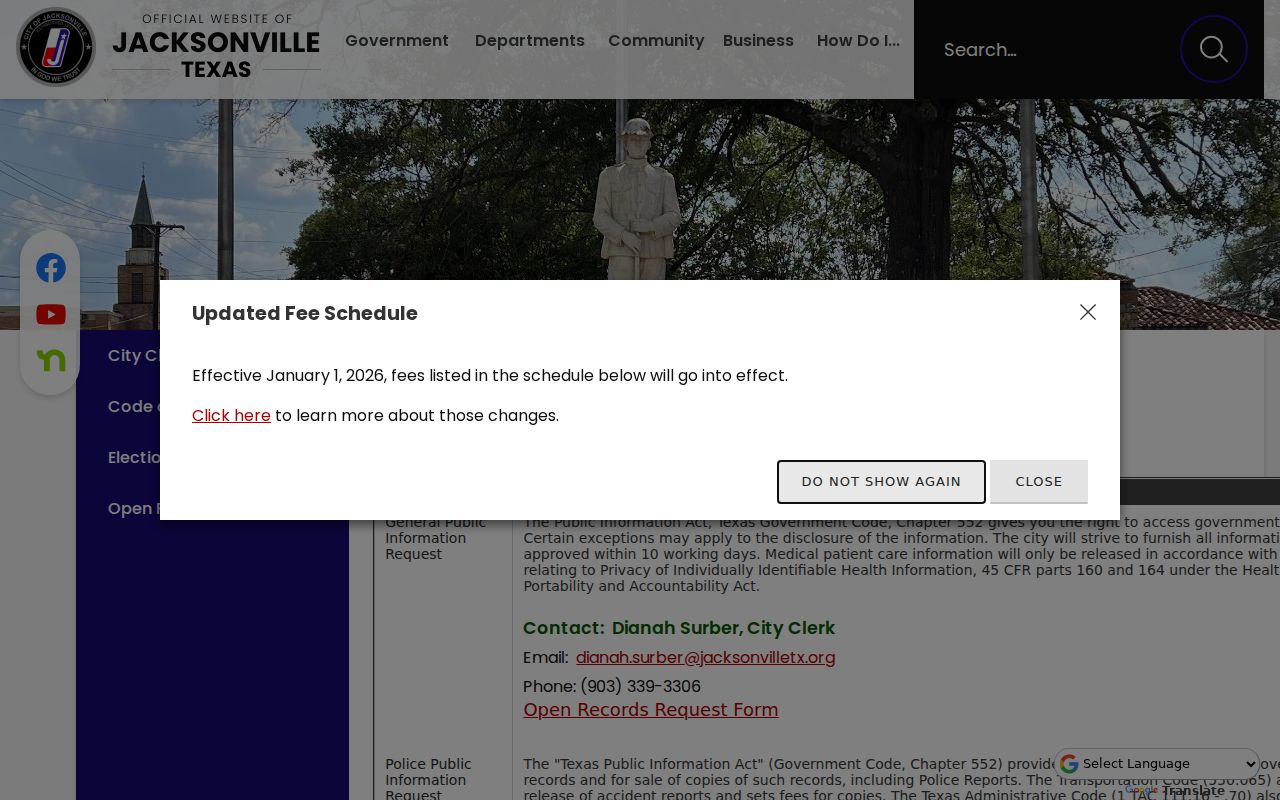
The screenshot reinforces the key routing point: police reports use the Jacksonville police channel, not the general city request path.
Jacksonville Crash and Incident Records
A Jacksonville crash report and a police incident report do not always travel through the same channel. Jacksonville police links a crash resource, while Texas also provides the TxDOT Crash Records Information System purchase route for eligible crash reports. An offense report, dispatch material, photograph, or body-camera video remains a request to the Jacksonville agency that created it.
Body-camera requests need more than a broad date range. Texas law requires enough detail to identify the recording, including the date and approximate time, the specific location, and the name of at least one person known to be a subject. Those details should be stated in a Jacksonville request. Protected victim data, juvenile information, active-investigation material, and other confidential content may be withheld or redacted.
Note: A redaction means part of a record is protected; it does not mean the Jacksonville event or report never existed.
Booking and Arrest Records in Jacksonville
A Jacksonville arrest may produce several files. The police report describes the officer's observations, legal basis, and alleged offense. A booking record documents intake and custody. A magistrate record covers warnings and bail, and a clerk's file begins when a prosecutor files a charge. These records are linked by the event, yet an arrest by itself is not proof of guilt.
Jacksonville does not advertise a long-term city jail lookup. For a custodial arrest, call Cherokee County Jail at 903-683-6365 and use the sheriff-linked VINELink status channel. Documentary booking proof can be requested from the Sheriff's Office at records@cocherokee.org. Then identify the arresting agency for the narrative. If prosecutors file a felony, the District Clerk is the county source. Class A and B misdemeanors begin with the County Clerk.
The broader Cherokee County arrest search explains the county jail and booking channels in more depth. Jacksonville readers should still return to JPD for the city officer's report.
Jacksonville Arrest Search Fallbacks
The lack of an official Jacksonville arrest blotter changes the order of a search. Begin with the known facts: who made the arrest, whether the person entered Cherokee County Jail, and whether a citation or court paper shows a case number. Call the jail for current custody, send a focused booking request for proof, and request the arrest report from Jacksonville police when JPD made the arrest.
After prosecutors have had time to act, check the right clerk. A filed charge may differ from the arrest allegation. A dismissal may appear in a court file before a statewide repository is updated. If the city, jail, court, and DPS layers conflict, compare dates and identifiers, then ask the office that created the disputed entry about its correction procedure. Do not turn an allegation into a conviction in notes or family research.
The Jacksonville Municipal Court File
Jacksonville Municipal Court handles Jacksonville police citations and school-related violations filed by Jacksonville ISD. The counter is at City Hall, 315 S. Ragsdale St., and its posted hours are Monday through Friday, 8 a.m. to 5 p.m. The court lists in-person and online payment routes, plus a phone-payment line at 877-520-8735. Payment is case action, not a public criminal-history search.
| Court Name | Jacksonville Municipal Court |
|---|---|
| Case Types Heard | Fine-only city matters, Jacksonville PD citations, and listed Jacksonville ISD school-related violations |
| Access Channels | Clerk counter, court phone, municipal payment link, and phone payment |
| File Contents | Citation, charge, plea, court setting, payment or compliance activity, and final disposition |
| Copies and Fees | Ask the clerk for copy and certification terms; no general fixed copy fee was documented |
The official Jacksonville court page is shown in the image below.
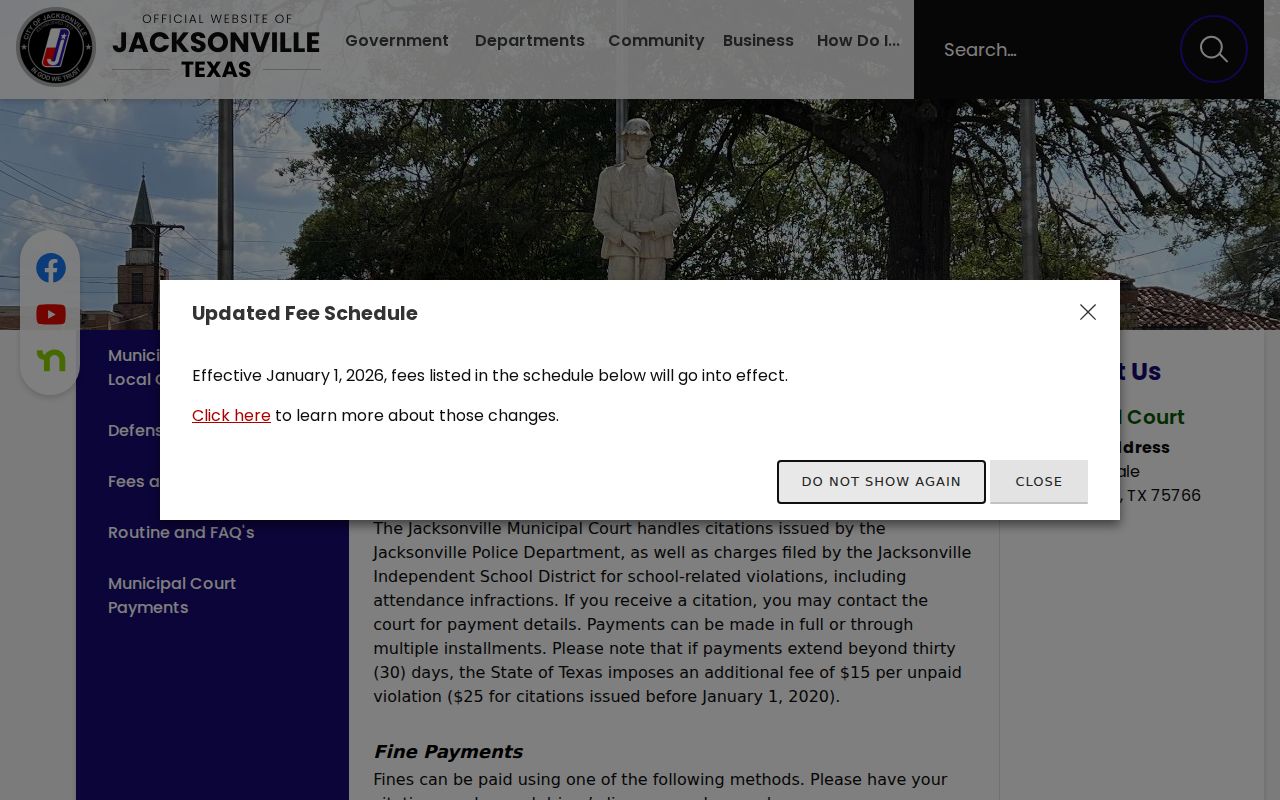
The court view helps separate citation resolution from the police report and from Cherokee County's felony and misdemeanor files.
Jacksonville Citation Record Searches
The Jacksonville municipal payment workflow tells users to have a citation number and driver's license number ready. Those fields help locate a payable citation. They do not expose every Jacksonville police report, jail booking, or county criminal case. Anyone who wants to contest a citation or ask about another legal option should contact the court before paying, because payment can resolve the matter.
The court permits full or installment payment. A payment that extends beyond 30 days carries the stated $15 state-mandated fee per unpaid violation, with older pre-2020 citations addressed separately by the court. Jacksonville also recognizes indigent hearings and possible community service. Juveniles under 17 must wait for a court-date notice and appear with a parent or legal guardian. Bench and jury trial paths are available.
Note: The municipal portal is a resolution tool tied to a citation, not an anonymous Jacksonville criminal record database.
How Jacksonville Records Reach the County
City and county records divide at the type of event. A fine-only Jacksonville citation remains in Municipal Court. A custodial arrest can produce a Cherokee County jail booking. Prosecutors may then file a felony in district court or a Class A or B misdemeanor through the county court system. Clerks report qualifying case outcomes into the Texas criminal justice reporting stream.
Record flow: Jacksonville Police Department › Cherokee County Courts › Texas Department of Public Safety
That line is not instant. Each stop creates and maintains its own record. For a recent event, city police and jail channels may show the first facts. For filed charges and disposition, use the clerk. The Cherokee County court case lookup covers the county court layer, while DPS supplies only the statewide public conviction and deferred-adjudication product authorized by Texas law.
Jacksonville Records Across Town
Jacksonville's geography helps explain why records do not all sit at one counter. The city's official history traces its name to Jackson Smith, whose home and blacksmith shop date to 1847. Railroad development shifted the settlement to its present site in 1872. Tomato production later became so central that Jacksonville adopted “Tomato Capital of the World” in 1987.
The official Jacksonville city home appears in the source-linked image below.
Modern record travel follows a similar city-to-county geography. Jacksonville reports and citations start locally, but county booking and higher court records are centered in Rusk.
Jacksonville Criminal Record Terms
Each Jacksonville file uses terms tied to its stage. A citation is a notice of an alleged fine-only offense. A booking is the jail intake record. A disposition is the court's final recorded outcome, which may be a conviction, dismissal, acquittal, or another result. “Pending” means no final disposition is recorded. These terms should not be blended.
- Complaint
- A sworn allegation used to begin or support a criminal charge.
- Docket
- The court's dated list of filings, settings, and case events.
- Bond
- Security or conditions set to help assure appearance and compliance.
- Disposition
- The recorded outcome of a charge or case.
- Deferred adjudication
- Supervision ordered while the court defers a finding of guilt; it is not a conviction.
A police allegation and a jail booking do not state the final result. The clerk's judgment or disposition is the key source for how a filed Jacksonville-related charge ended.
Jacksonville Record Access Rules
Jacksonville police records are requested under the Texas Public Information Act, subject to exceptions and redaction. Court case records follow separate court law because the judiciary is outside that Act. DPS criminal history is also governed by separate dissemination rules. Public DPS output is limited to conviction and deferred-adjudication information made public by statute, while fingerprints remain the sound route for a person reviewing their own identity-linked Texas history.
Key Statutes:
Texas Government Code Chapter 552 grants access to public information held by covered agencies, subject to exceptions.
Texas Government Code Sections 411.083 and 411.135 govern DPS criminal-history confidentiality and the public conviction/deferred-adjudication release.
Texas Occupations Code Section 1701.661 requires specific identifying details in a body-camera request.
Ask for an existing Jacksonville record and state the event details. An agency can release public parts, redact protected data, or cite a legal basis for withholding material. Verify any result with the office that maintains the original file.