
Criminal Court Cases in Cherokee County
Cherokee County criminal cases divide by offense level. The 2nd and 369th District Courts exercise felony jurisdiction, and the District Clerk keeps their filings at the county courthouse in Rusk. The County Court at Law hears Class A and B misdemeanors plus Class C appeals, while the County Clerk maintains those filed misdemeanor records. Justice courts and municipal courts keep their own fine-only Class C matters and may issue warrants. Appeals from Cherokee County district and county courts go to the Twelfth Court of Appeals in Tyler.
This split matters at the start of a search. The judge's office manages hearings, but the filing clerk holds the pleadings, orders, and judgment. A recent arrest might not yet have a case number, and the prosecutor may file a different charge from the booking allegation. When the level is unclear, check both the district and county clerks, then the relevant justice or municipal court. The broader Cherokee County arrest search explains why the booking trail can precede a court filing.
Cherokee County Felony Case Files
The District Clerk is the practical first stop for a Cherokee County felony case. Its criminal counter is on the second floor of the courthouse at 135 South Main Street, Rusk, Texas 75785. Public hours are Monday through Friday, 8:00 a.m. to noon and 1:00 to 4:00 p.m., excluding holidays. Call 903-683-6908 or email dcoffice@cocherokee.org. Give a case number when known. Otherwise, ask what name details and filing years the clerk can search, and whether an older file needs advance retrieval.
The District Clerk states that civil, criminal, and family filings have been electronic since November 1, 2018. That fact does not create a free county public name-search portal. Ask for the register of actions or docket sheet, charging instrument, motions, orders, judgment, sentence, and any appellate notice. Confirm whether inspection, emailed copies, paper copies, or certified copies are available and what current charge applies.
The Cherokee County District Clerk page identifies the official filing counter and contact route.
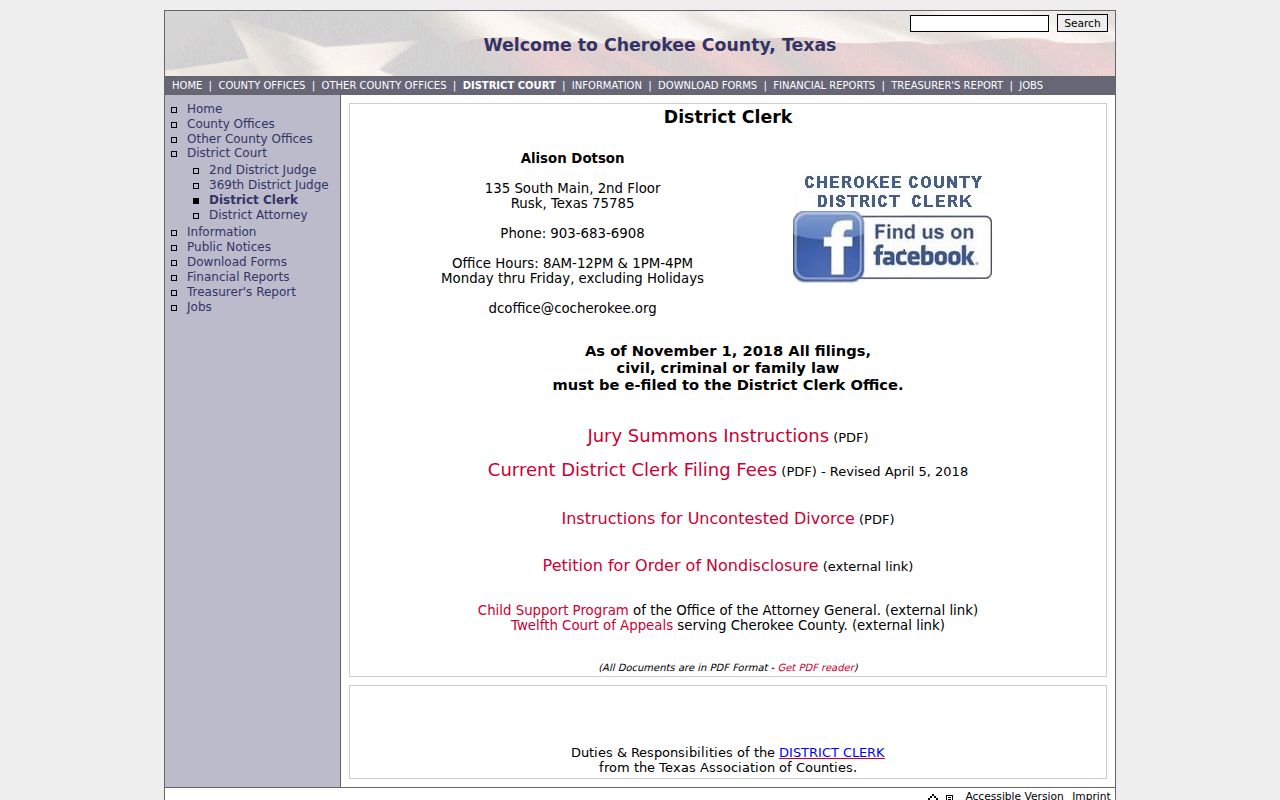
This view anchors the felony-record route in the office that maintains the original Cherokee County district case file.
District Clerk Criminal Counter
135 South Main Street, 2nd Floor
Rusk, TX 75785
903-683-6908
dcoffice@cocherokee.org
Monday-Friday, 8 a.m.-noon and 1-4 p.m.
Cherokee County Case Record Searches
No official Cherokee County criminal-case query form was available for an anonymous field-by-field inspection. A sound lookup therefore starts with jurisdiction and uses the clerk as the search channel. re:SearchTX can supply statewide electronic context where participating clerks provide data, but coverage and document access vary. The certified local judgment remains the strongest source for a Cherokee County disposition.
- Identify whether the alleged offense is a felony, Class A or B misdemeanor, fine-only Class C matter, or municipal ordinance case.
- Contact the District Clerk for a felony or the County Clerk for a Class A or B filing. Give the case number, name, and approximate filing or arrest date.
- If neither clerk finds it, check the correct justice or municipal court and ask whether an old case is in an off-system archive.
- Review the docket and request the charging paper, orders, judgment, sentence, and any appeal notice rather than relying on one status label.
- Compare re:SearchTX or DPS repository results with the clerk file, then ask the contributing office to correct a proven mismatch.
The statewide portal provides a useful second view when Cherokee County electronic records participate.
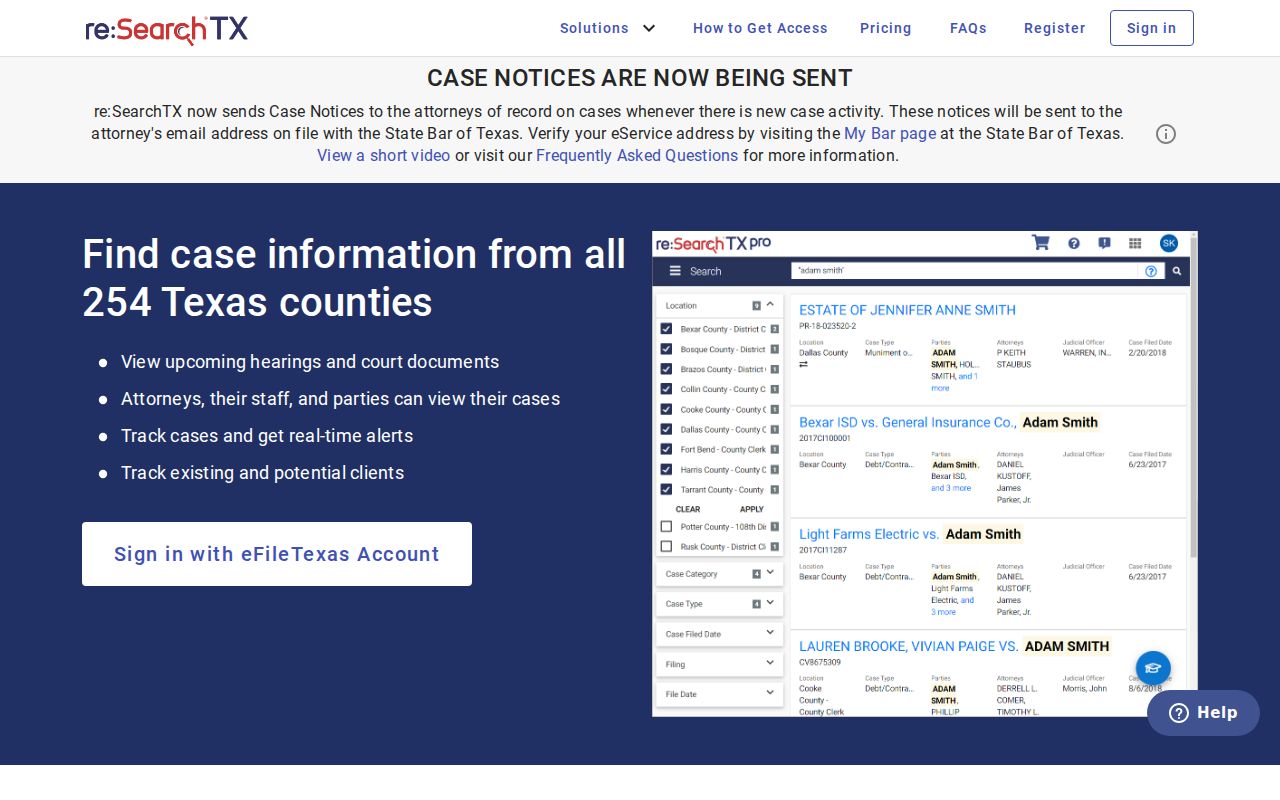
The image illustrates why statewide access is a supplement to the local clerk, not a guarantee that every paper or older case appears.
| Interface item | Type | Required | Confirmed behavior |
|---|---|---|---|
| County Court at Law docket list | Browsable document collection | No | Shows scheduled docket documents linked from the court page. |
| Name field | Not published | Not published | No countywide public case-query field was confirmed. |
| Case number field | Not published | Not published | Supply a known number directly to the clerk. |
| Court or date filter | Not described | Not described | Ask the clerk about indexed years and archive retrieval. |
| Search, reset, or export | Not described | Not described | No official county behavior was verified. |
Cherokee County Misdemeanor Case Files
The Cherokee County Court at Law handles Class A and B misdemeanors and appeals of Class C cases. Its office sits on the courthouse ground floor and is open Monday through Friday, 8:00 a.m. to 5:00 p.m., excluding holidays. The court number is 903-683-6497. Filed copies, however, come through the County Clerk at 903-683-2350, fax 903-683-2457, or P.O. Box 420, Rusk, Texas 75785.
That court-and-clerk distinction is easy to miss. The court page can help with a scheduled docket, while the County Clerk is the record keeper for the filed misdemeanor case. Verify a setting directly because a posted docket can change. A Class C matter can also reach this court on appeal, even though its first file began in a justice or municipal court.
The official Cherokee County Court at Law page confirms its local criminal jurisdiction and contact point.
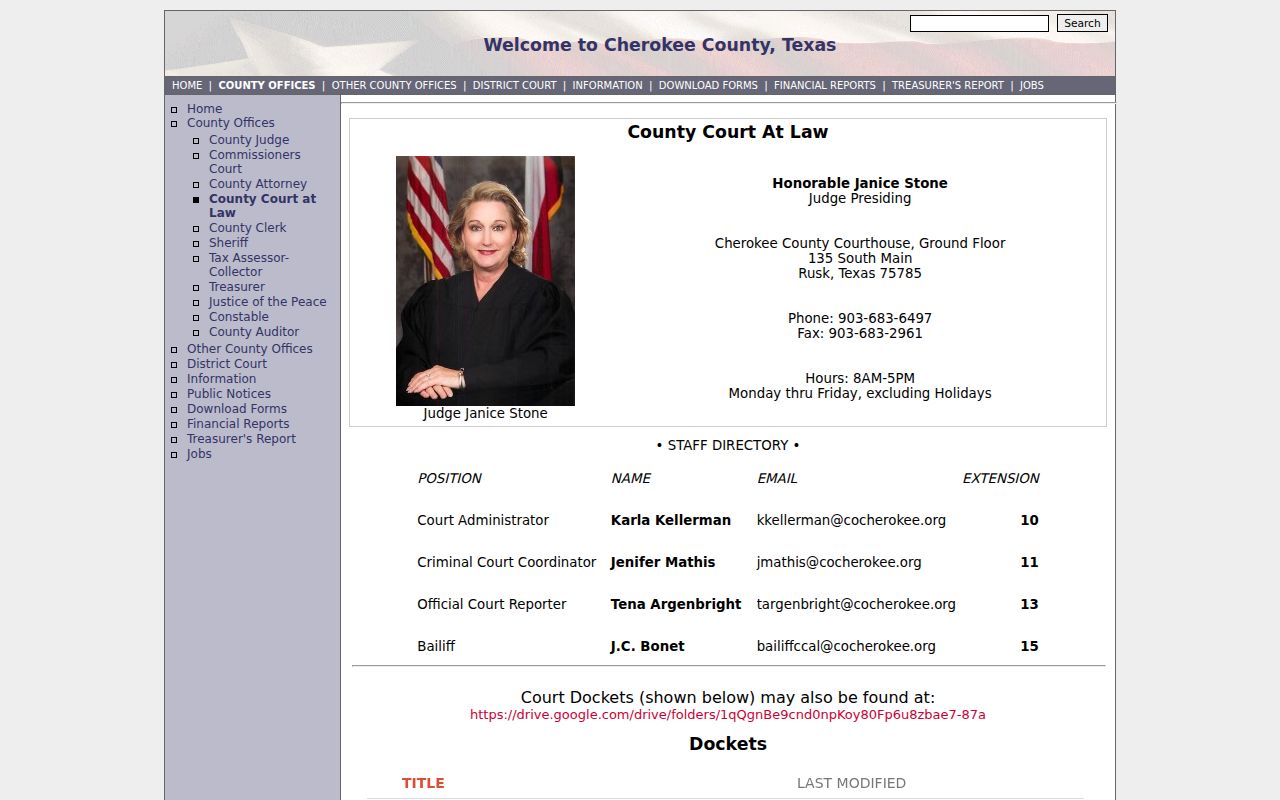
This source helps separate the judge's docket function from the County Clerk's custody of filed case records.
What a Criminal Case File Contains
A Cherokee County criminal case file records what prosecutors filed and what the court did. It may contain far more than a summary result. The docket orders events by date, the charging instrument states the formal allegation, and the judgment gives the final outcome. Bond, costs, restitution, and sentence are separate fields. A request should name the exact documents needed because the county has no verified public display containing every common field.
| Case Number and Court | Identifies the local file and whether it belongs in district, county, justice, or municipal court. |
|---|---|
| Charging Document | A complaint, information, or indictment states the charge actually filed, which may differ from the arrest allegation. |
| Docket Entries | The register of actions lists filings, settings, orders, and other recorded events in date order. |
| Hearings and Pleas | Entries may show arraignment, pretrial settings, plea terms, trial activity, and continuances. |
| Disposition and Judgment | The final record may show dismissal, acquittal, deferred adjudication, or conviction. |
| Sentence and Conditions | The judgment may state custody, community supervision, fines, costs, restitution, and other court-ordered terms. |
“Disposed” only means the court completed the matter. It does not always mean conviction. “Deferred adjudication” means the court postponed a finding of guilt while imposing community supervision. Read the judgment rather than guessing from a short docket code.
Cherokee County District Court Numbers
The 2nd and 369th District Courts both serve Cherokee County felony matters. The 369th also serves Anderson County, so the court number and county designation on the case header are important. Both Cherokee County felony files route through the District Clerk's Rusk counter. Do not assume a search of one judge's page is a full search of both district-court files.
The official 369th District Court page supplies the court-specific source for that part of the local felony structure.
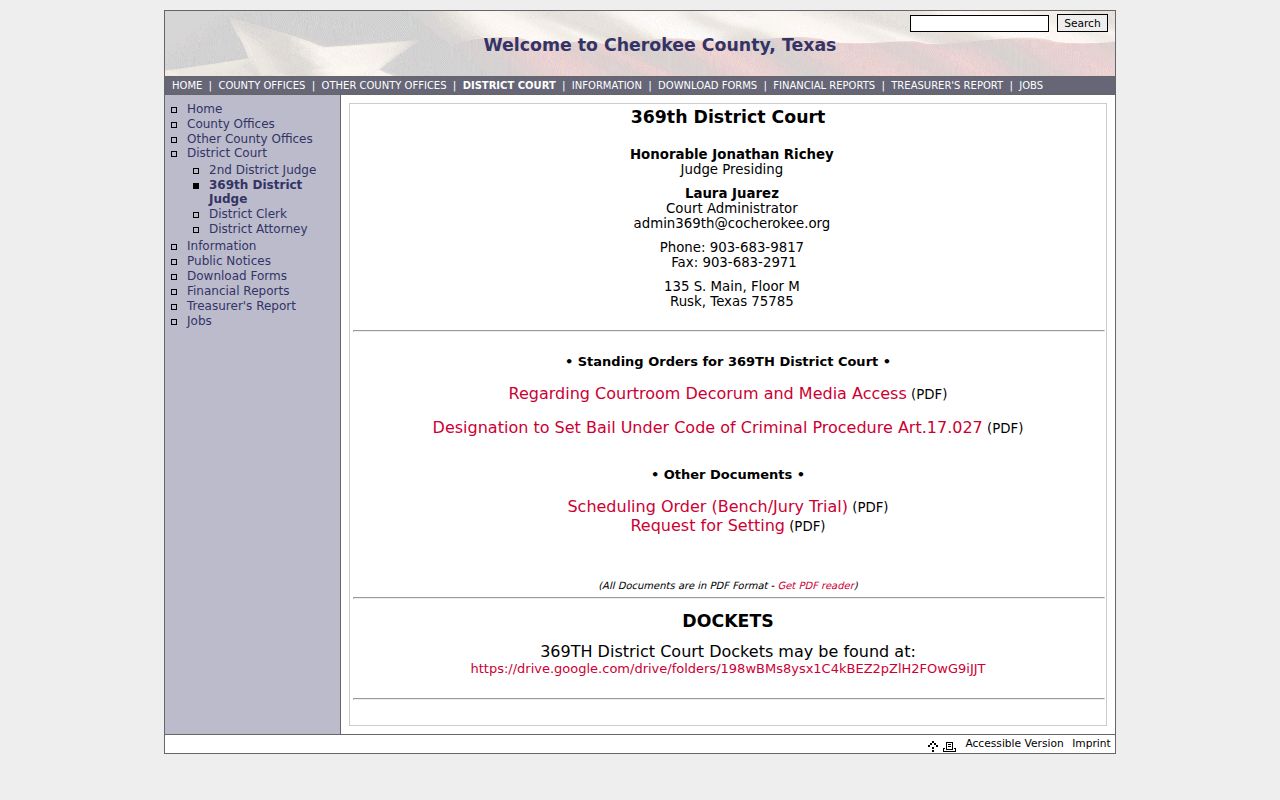
The court view is useful for orientation, while the District Clerk remains the custodian to ask for the underlying Cherokee County filing.
Criminal Case Stages in Cherokee County
A Cherokee County case can produce a new paper or docket entry at each step. An officer first creates the arrest record, and the jail may create a booking file. A magistrate gives required warnings and addresses bail without unnecessary delay, generally within 48 hours after arrest under Article 15.17. Prosecutors then decide what to file. Felonies ordinarily move from complaint to grand-jury indictment, while misdemeanors may proceed by information.
Case flow: Charges Filed › Arraignment › Pretrial › Plea or Trial › Disposition › Sentencing
A dismissal, acquittal, deferred adjudication, or conviction ends the trial-stage charge in different ways. An appeal creates a separate appellate record at the Twelfth Court of Appeals, but the Cherokee County trial clerk retains the original file. Timing varies by case, so no fixed local duration should be inferred from this sequence.
Cherokee County Docket Versus Case File
A docket is a timeline, not the whole Cherokee County case file. It can show that an indictment, motion, order, or judgment was entered without displaying the document's full text. A scheduled docket document is also not proof that a hearing occurred exactly as listed. Ask the clerk for the filed instrument when its substance matters.
- Docket
- The court's chronological list of case events and settings.
- Indictment
- A grand jury's written felony accusation, also called a true bill.
- Information
- A prosecutor-filed charging paper commonly used in misdemeanor cases.
- Disposition
- The recorded outcome of a charge or case.
- Judgment
- The court's formal record of the result and any sentence.
Note: A short status label cannot replace the filed judgment when confirming how a Cherokee County charge ended.
Cherokee County Federal Case Boundaries
Federal charges do not appear as Cherokee County district-court cases. Cherokee County lies in the Tyler Division of the U.S. District Court for the Eastern District of Texas. Federal dockets and filed documents use PACER after registration. That system charges under its current federal schedule and is distinct from the local district and county clerks.
The official PACER court records service is the direct source for a federal docket.
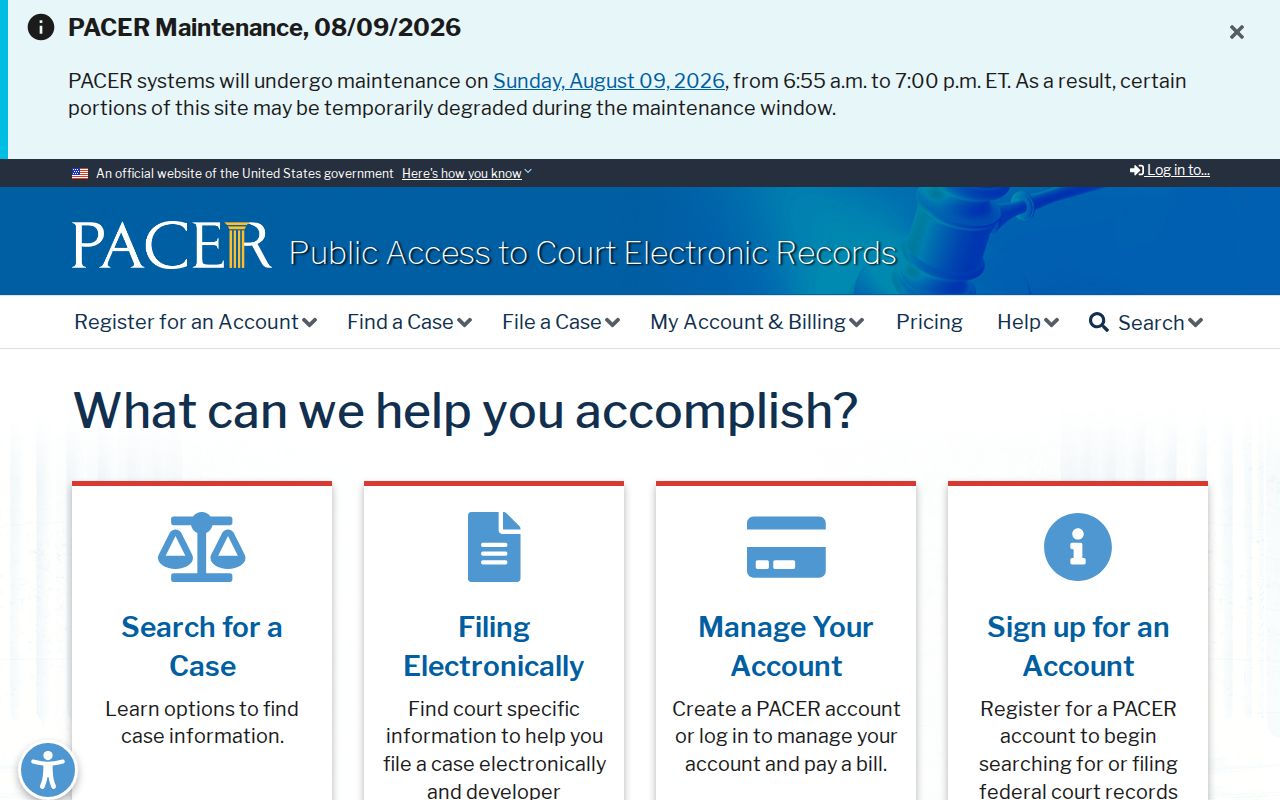
The federal portal marks a clear jurisdiction line: it does not search Cherokee County misdemeanors, justice cases, or municipal matters.
Access Rules for Case Records
Texas court-case files do not follow the Texas Public Information Act in the same way as sheriff reports. The judiciary is excluded from that act, and Texas court records guidance directs people to the appropriate clerk for case files. Rule 12 of the Texas Rules of Judicial Administration governs qualifying judicial administrative records, but it does not govern records created or filed in a court case.
Ordinary adult criminal case material may be open, subject to governing law and court rules. Juvenile files, sealed or expunged matters, nondisclosed criminal-history information, victim-identifying data, and protected personal identifiers receive different treatment. An absent online result does not prove there was no Cherokee County case. Ask the clerk about redactions, older indexes, and restricted status. If a court file and DPS record conflict, obtain the local judgment and use the contributing-agency or DPS correction route.
Access point: Government Code Chapter 552 covers public information held by many agencies, but Cherokee County court-case access runs through the clerk and applicable court law.